Overview
Public-Private Partnerships (PPPs) cover a range of contracts between governments and private investors, balancing risk and responsibility for capital investments. They can range from management contracts to full privatization. Well-structured PPPs create jobs, attract private capital, and improve efficiency.
Jamaica’s PPP Policy defines PPPs as contracts where the public and private sectors collaborate in designing, financing, building, and operating infrastructure or services, with appropriate sharing of risks and rewards.
The policy provides a framework to standardize implementation, attract investment, increase productivity, and limit fiscal risks. PPPs must:
Transfer risks to the party best able to manage them
Deliver value for money
Remain fiscally responsible
Ensure transparency and fairness
History
Since the 1980s, Jamaica has implemented PPPs such as the Jamaica Private Power Co. plant, Sangster International Airport, and Highway 2000. Early projects lacked a formal framework, but activity has grown.
In 2008, fiscal reforms pushed MDAs to partner with the private sector to deliver infrastructure and services while managing risks and costs. To strengthen this approach, the PPP Policy was approved by Cabinet in September 2012 to guide decision-making and ensure consistency across government projects.
The Jamaican PPP Policy, which was approved by Cabinet in September 2012, sets out the principles that should guide decision-making by MDAs which are considering utilising PPPs to improve infrastructure and the delivery of public services.
Regulatory Framework
The Government of Jamaica has identified PPPs as a means of stimulating economic growth in the Jamaican economy. The PPP Programme will be undertaken within the context of the existing legal framework.
The administration of the PPP process may be captured in two broad institutional structures: strategic and operational.
- The strategic responsibilities include the approval of policies and strategies for the implementation of PPPs and take into consideration the alignment of the PPP Policy with the other broad economic strategies of the GOJ. These activities will include approving the PPP Policy and list of PPP opportunities.
- Operational responsibilities are tied to the day-to-day administration of the programme implementation including management of all elements of the transactions and providing advisory support to the GOJ teams charged with strategic oversight of the programme.
Two (2) committees will have strategic oversight of the PPP Programme:
- The Cabinet
- Privatisation Committee of Cabinet, supported by recommendations from a Strategy Committee
Guiding Principles of the PPP Programme
The PPP Programme will be guided in all cases by four (4) over-riding principles:
- Optimal risk transfer – each identified project risk shall be allocated to the party that is better able to manage, control and bear the impacts of that risk.
- Achieving value for money for the public – the PPP must have benefits that exceed its costs, and be the least-cost practical way to achieve those benefits.
- Being fiscally responsible – any PPP that involves fiscal support (whether through planned payments or guarantees) will be scrutinized to ensure that the fiscal commitments are affordable, and not likely to be destabilising.
- Maintaining probity and transparency – making sure that the public is informed at all times about candidate projects, and that no person is unjustifiably advantaged or disadvantaged by the project.
Exemption
Housing PPPs, which are the responsibility of the Minister of Housing, being undertaken under the Housing Act are exempted from this Policy. Therefore, the Housing PPP Policy is applicable to Public-Public Private Partnership agreements with the objective of developing housing solutions, which are to be promoted by the Minister of Housing or related agencies under his authority.

The Process
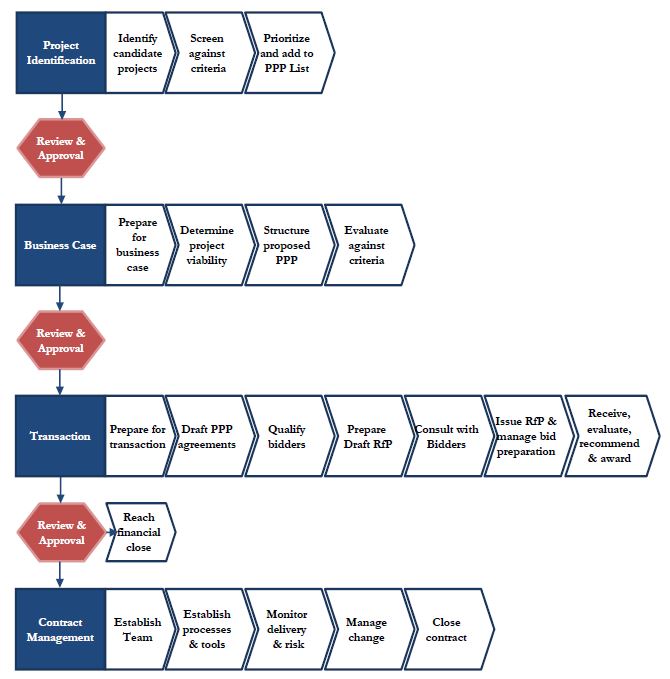
The PPP development process consists of four stages. Each stage is made up of a series of defined tasks. At the end of each stage, projects will be reviewed and submitted to Cabinet for approval to proceed to the next stage.
- Project Identification – find those assets and services – existing or planned – where value for money could possibly be increased if they were done as PPPs.
- Business Case – is the development of a thorough report on the candidate project (the “Business Case”), which will be submitted to Cabinet for approval to proceed with procuring the project as a PPP.
- Transaction – is when bidders are actually requested for the project, qualified, and then invited to bid.
- Contract Management – the Government needs to ensure that the promises in the contract are delivered, and that new events are responded to intelligently.